Showing posts with label Fantastic Future Friday. Show all posts

Fantastic Future Friday: Dawn


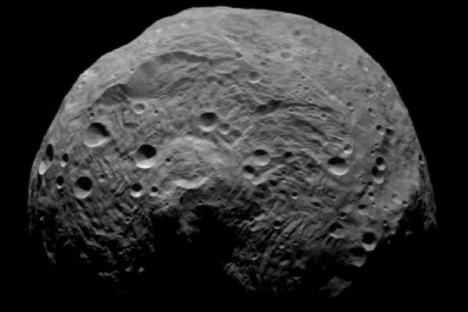
Lost in the reporting about the Space Shuttle retirement the Dawn mission went under reported. The Dawn spacecraft is investigating the two largest asteroids in the Solar System. Vesta and Ceres. Last week it went into orbit around Vesta. NASA is holding a press conference on August 1 to explain the findings in detail.

These two asteroids have a special place in my heart as they were the setting for my book THE SETTING EARTH which is free to download this weekend.

The real work of the Dawn Spacecraft won't begin until she settles into orbit and can start taking readings, but she has already discovered some mysteries.

Vesta is one of the shiniest objects in the Solar System. It was thought that its shininess was because it is primarily composed of Iron-Nickel, a very tough metal. However the impact craters on its surface are much shallower than one would expect if is was all Iron-Nickel, so there is something about its surface composition that we don't know that makes the impacts shallower than predicted.

It also has some huge grooves that go completely around the proto-planet. We can speculate how those were formed but until we get more information that speculation is pretty meaningless. Some of the smaller grooves were expected. Those little lines are most likely formed as giant boulders shook loose and started rolling across the surface. In the very low gravity they continue to roll for quite a long time.

Over the coming months Dawn will make more and more discoveries. As she settles into orbit we will be able to determine the exact mass and density of Vesta. We will get a much better look at her surface and find out what caused these mysterious features.

One thing I do expect from the Dawn Mission is the unexpected. Whenever we explore new worlds we always find things that fill us with awe. The Voyager probes revealed that Jupiter has a system of moons that are worlds in their own right with liquid oceans under the ice that not only will make them good places for colonization but might harbor life of their own.

Revisiting the Earth's Moon we discovered that the Apollo Missions landed on the driest parts of the lunar surface. That probably wasn't a coincidence, safety engineers like to have people land on the flattest, most boring surfaces just because landing in craters and on the sides of mountains increases the dangers exponentially.

Dawn is the first spacecraft to orbit a large asteroid and she sure to make some amazing discoveries. Soon Vesta will show herself to be a unique world with strange properties that no one imagined. As we learn about these we can figure out uses for this new world and that will lead to a fantastic future.

By Darrell B. Nelson author of I KILLED THE MAN THAT WASN'T THERE

Fantastic Future Friday: Goodbye Shuttle


Today, hopefully, Atlantis will launch and it will be the final mission for the Space Shuttle Program.

The biggest problem with the Space Shuttle was it worked good enough.

When it was originally conceived there was supposed to be 20 shuttles that would rotate through with a launch every two weeks. This would lower the cost per launch dramatically as their would always be a shuttle in space, one being prepped, one being reconditioned after the mission. So even though NASA would have a much bigger workforce, there would be no downtime.

Two things killed that plan. Budget cuts forced NASA to only have 4 shuttles. So they hoped for a launch every month.

Unfortunately, the shuttle wasn't quite reliable enough for that schedule. However it was reliable enough to ensure the space program could go on. If it were a little less reliable it would have been scrapped earlier and replaced with something more reliable. If it were reliable enough to hold the once a month schedule America could have built its own space station in the 90s and open up new markets in space. That would force congress to give space exploration a bigger budget and NASA would have to build a new space craft.

Since the Space Shuttle was “good enough” all our space missions revolved around a few launches every year.

It also wasn't the safest design. Placing the crew next to the engines, instead of on top of them, was riskier but not so risky to stop the program.

2 out of roughly 100 missions ended in disaster, 2%. That is good enough odds for most people wanting to go in space. I'd take those odds. But it meant huge redesigns to try and give better odds. If it had been less safe, a safer replacement would have been made. If it were safer there would have been more missions per year. The Space Shuttle was “Safe Enough” to keep flying.

It was also expensive, half a billion dollars per launch. If it were more expensive it would be worth going back to the drawing board and coming up with a new one. If it were less expensive there would be more launches and more things done in space giving NASA a powerful reason to build a successor.

In the end it was “Cheap Enough” to keep the program going.

The problem of having the Space Shuttle being “Good Enough” at everything is in building a replacement its hard to justify taking the next small step in improvement. If the Space Shuttle can do 4 to 8 missions a year, it's tough to justify spending billions to replace it with one that can do 8 to 12 missions a year. So any replacement had to have a two week turnaround time. That would be a remarkable feat.

Having the Space Shuttle being “Safe Enough” meant a replacement needed to be as safe as an airplane. Something that is probably impossible.

Having the Shuttle being “Cheap Enough” to fly meant it was hard to justify building a new craft that had a 20% saving or $100 million per launch. So any replacement needed to have huge cost savings.

The Space Shuttle was a remarkable machine, but it was cursed by being good enough not to justify building a replacement but not so great that a true successor could be built.

With the end of the Space Shuttle program new spacecraft can be built that are slightly better, not so much better that they are impossible.

Getting the odds of disaster down to 1 in 100 is doable and insurable. $150,000 per flight per passenger in insurance.

One launch per month is doable.

Getting launch costs down 20% per ton. Is doable.

Perfect is the enemy of good as perfect is impossible. With the end of the Space Shuttle program we can look to build a better spacecraft instead of trying the impossible and building the perfect spacecraft.

So goodbye Space Shuttle, if you were a little better or a little worse you would have been replaced years ago. If congress is willing your retirement will lead to a slightly better replacement and that will lead to a fantastic future.

By Darrell B. Nelson author of I KILLED THE MAN THAT WASN'T THERE

Fantastic Future Friday: Canada Edition


Happy Canada Day, Eh.

Since it both a Friday and Canada Day I thought I'd highlight the Canadian contributions to the space program.

The Canadians have managed to contribute a lot to space exploration with a comparatively small budget. The most complex tasks that the Space Shuttle did, launching the Hubble telescope and building the ISS, couldn't have been done without the Robot arm or Canadarm built in Canada to mimic the human arm on a huge scale.

They also built the MOST (Microvariability and Oscillations of Stars or Microvariabilit et Oscillations Stellaire) Telescope, not only a powerful inexpensive space telescope but they managed to get the abbreviation to work in both languages. The MOST is a tiny telescope 2' x 2' x 1' and weighs 124 lbs. It cost $7 million dollars.

The nice thing about (pronounced “Aboot”) the MOST is it can stare at one star for up to two months at a time and can detect tiny changes in the brightness.

Canada has also built science equipment that has been placed on the ISS the Phoenix Mars Lander and the James Webb Space Telescope.

So to CSA (Canadian Space Agency) I'd like to say, “Happy Canada and keep up the good work.” It the Canadians can keep adding to our understanding of the universe with innovative scientific equipment made at comparatively low cost it will lead to a fantastic future.

By Darrell B. Nelson author of I KILLED THE MAN THAT WASN'T THERE

Fantastic Future Friday: Interstellar Travel

DARPA has announced a contest where they will offer half a million in seed money to a private company that can come up with a blueprint to travel to another star in the next hundred years.

This is a huge undertaking, and I don't see how it can be done in only one hundred years. I do realize one hundred years is a long time for scientific progress. A hundred years ago Godard was just starting to experiment with rockets and IBM was selling the first of the Tabulating Machines. Now private companies are going into space and computers are everywhere. However traveling to the nearest stars seems like too big of a leap.

Our current space ships only have the power to break Earth's orbit. There are designs for Magnetic Field Oscillating Amplified Thrusters, using fluctuating magnetic fields to induce density waves in electric conductive media, that could allow a spaceship to reach speeds of 260 Kilometers per second or nearly 1/1,000th of the speed of light. These ships that are more advanced than anything we can build right now would take 4,000 years to reach the nearest star. Knowing my luck there would be an annoying kid kicking the back of my seat for the whole 4,000 year trip.

These ships would open up the inner solar system but would still leave the outer solar system where all the good stuff is isolated.

I've talked before about a giant space based solar power plant in Mercury's orbit to create antimatter to power ships at speeds of up to 6% of the speed of light. But even with real research and development budgets (3 to 5% of Earth's GDP) I really don't see that happening in the next hundred years.

A faster way to get something up to the speeds necessary to cross Interstellar space, at least 1/10 the speed of light so the nearest stars are only 40 years away, is with lasers and mirrors.

You could launch a lot of small craft, if you consider the largest spacecraft we've ever launched small, that are just solar power platforms with huge lasers into low orbits around the Sun. You could then have a ship that had a huge mirror on its back and the lasers around the Sun could aim at it speeding it up to the necessary speeds. This could get a ship to the nearest stars by 2100, however I've got no idea how you would stop the ship once it got there. This would work great for sending a probe to the nearest stars, as it would spend a good 5 hours in the inner solar system of that star, but it's not such a great idea for humans.

It would be possible to send a lot of small probes, weighing couple of pounds each, with a mirror made of buckypaper a mile wide so it could use it as a solar brake as it got near the star. This would work best with Alpha Centuri as you could use it's three stars to slow down. Then use the huge mirrors to concentrate the star's light to a solar panel to power a laser to slow the probes coming from Earth until you had enough lasers around Alpha Centuri to slow down a spaceship carrying humans. But getting all that in place in the next 60 years in order to hit the DARPA deadline of one hundred years, taking into account the 40 year voyage, seems a little far fetched.

The final option for reaching the nearest stars within a hundred years is something that is at the same stage as computers or controlled fusion were a hundred years ago. It might work or be a pipe dream. The Neutrino Drive. The idea is if you could find a way to store Neutrinos you could use them to power a space ship. Neutrinos have no mass or charge, so your fuel would weigh nothing. You could take as much fuel as you needed and you wouldn't have to use fuel to accelerate it. A ship with Neutrino drive could get near the speed of light and still be able to slow down. The question is can a method of storing Neutrinos ever work.

If it can it will lead to a fantastic future within the next hundred years.

By Darrell B. Nelson author of I KILLED THE MAN THAT WASN'T THERE

Fantastic Future Friday: It's up

I've posted my Future Friday post on my writing blog. HERE

It's not that fantastic as it deals with fictional weapons. What it is fantastic, at least for me, is that I'm typing at nearly my old speed as my finger has healed enough to use it again, with only a little discomfort.

By Darrell B. Nelson author of I KILLED THE MAN THAT WASN'T THERE

Fantastic Future Friday: Mars

Ground penetrating radar has unearthed (unmarsed?) a great find. A huge bed of frozen CO2.

Thawing out this bed of CO2 would only double the pressure of the Martian atmosphere, so the majority of the planet would still be unable to have liquid water. But in the lowest depths of the Valles Marineris doubling the air pressure would make it thick enough for liquid water. That would be enough to transport life to the planet and jump start the process of terraforming it to be an Earthlike world.

A second habitable world in the solar system will lead to a fantastic future.

By Darrell B. Nelson author of I KILLED THE MAN THAT WASN'T THERE

Fantastic Future Friday: Extra Strength Placebos


In an astounding breakthrough a researcher has discovered a Placebo that is twice as effective as regular Placebos and 4 times as effective as the Generic Placebos. Read the Study.

Breakthroughs like this will lead to better and better Placebos and lead to a Fantastic Future.

Happy April Fools Day, everyone.

By Darrell B. Nelson author of I KILLED THE MAN THAT WASN'T THERE

Going Nuclear II

Back in January I wrote post, badly, about a problem with Nuclear Power Plants that no one seemed to be addressing which was that the huge amount of water needed for a Nuclear Power Plant to operate limits where they should be placed to the coastlines of the Oceans and Great Lakes. Going Nuclear

The nuclear crisis in Japan underscores this problem in a way I hadn't even thought of.

As of today it looks like the Japanese reactors will be brought back under control thanks to first of all 50 engineers who volunteered their lives (they've taken lethal amounts of radiation in order to keep the plant from melting down). Second to the huge amount of sea water that the fire departments and army were able to pour onto the reactors.

Because the reactors were built right on the coastline the Japanese were able to flood the reactors keeping them cool enough not to meltdown while power could be restored to the cooling pumps. Because of this action it looks like the high level radioactive fallout will be contained to an 18 mile radius. (This is all subject to change as the reports from there change hourly).

Looking at the Japanese Nuclear Crisis, it seems obvious that any new reactor built in the US (or anywhere really) should take the knowledge learned from this crisis and apply it to the design.

Unfortunately, from what I am hearing, this is not the case. They are looking at what happens if an Earthquake of historic size hits a reactor but that doesn't address the two basic problems.

First, the current reactors have active pumping systems to cool the core, so if something goes wrong and electricity can't power the pumps you get a situation like you have in Japan. It doesn't take a historic earthquake to make the pumps lose power. The HB Robinson plant in South Carolina was shut down twice in six months because the contractor used the wrong size electrical wire when upgrading the pumps.

Any new reactor needs to have a passive control system to cool the core in case of an emergency, or we will get another crisis like Japan.

Second, there needs to be a system in place to cool the entire plant in case of disaster. In Japan they came up with the plan to flood the reactor with seawater on the spot. They should have had the equipment in place for last ditch effort when the plant was built.

I am fairly pro-nuclear power, it has a lot to offer, but in order for it to be a viable alternative to fossil fuels these are seem fundamental engineering problems that need to be addressed.

By Darrell B. Nelson author of I KILLED THE MAN THAT WASN'T THERE

Fantastic Future Friday: I won't shut up about this.

In his State of the Union address, Obama once again hit on the idea of using the money we give to energy companies in subsidies to research ways to move beyond fossil fuels. So I thought I'd look at what we could do with that money.
First the facts: The federal government gives the oil and gas industries $36 Billion in subsidies and the coal industry $17 Billion. So that is $53 Billion dollars to work with, more than one-third the cost of the Apollo Program adjusted for inflation.

The first most direct cost comparison is high speed rail. The administration has proposed spending $54 Billion over the next 5 years on high speed rail. So for a little more than what we give to the fossil fuel industries in one year we could fund the construction of a high speed rail network that will be spent over the next 5 years.

I'm a little saddened that a Louisville, KY – Lexington, KY – Cincinnati, OH line wasn't added. These cities are fairly close together and it would make great economic sense to reduce the travel time between them to under 40 minutes, but I think it is because we send the craziest people we can find to the Senate that Kentucky isn't part of these plans.

In countries where high speed rail systems have been built they quickly become the preferred way to travel with more people riding them than car and air travel combined to go between major cities.

Solar water heaters, 10% of the residential energy used in the United States is for heating water. Solar water heaters first went commercial in the early 70s and have been improved on for 40 years. I personally built one for $40 and had 16 gallons of hot water to use every day for free over an entire summer.

The most expensive state of the art high tech units that heat 120 gallons and come with a 25 year warranty (that's right 5 times the life of a conventional water heater) cost 1,000. For what we give to the fossil fuel industries we could equip roughly half the homes in America with Solar Hot Water heaters that make conventional ones look like antiques. Or we could give Americans a $400 credit for buying a solar hot water system and people could buy the low end 80 gallon systems for next to nothing or splurge and spend $600 for the top of the line.

Those are just two ideas of what we could do with the money we give to the fossil fuel industries, I'll think up more in the coming weeks.

By Darrell B. Nelson author of Alien Thoughts

Fantastic Future Friday: Mental Health


One undeniable fact of the Arizona tragedy is that the shooter was mentally ill. If he hadn't decided on a political assassination he might have targeted a school or a mall. I unfortunately know quite a few people who struggle with mental illnesses (not to the point that they are dangerous) so I have done a bit of research on this topic in the past.

What is a mental illness?

This question sounds stupid but it really isn't. A lot of the mental illnesses that make people anti-social are actually evolutionary hold overs from a time when anti-social behavior was a benefit to society. That sounds strange but when humans lived in small tribes of hunter/gatherers having an anti-social couple helped to ensure tribe survived, by casting those members out. When an anti-social couple left a tribe they would then have to create a new settlement and humans spread around the world. Naturally if every member of the new settlement was anti-social the society would break down, so for it to be beneficial anti-social thinking had to skip a generation or two so it is tied to many different genes that turn violent when combined. So there is a large genetic component to the mental illnesses that lead to anti-social behaviors.

What is the historical treatment of mental illness?

Crazy people have been around throughout history, when we were hunter/gatherers they were cast out. As the human population grew to the point that this wasn't an option they were locked up. In the 1800's Sigmund Freud developed a more clinical way of dealing with mental illness. Even though most of his ideas were wrong, in psych class I loved when his name popped up on a test as I knew the answer was he was wrong, the idea of talking to a person with a mental illness and finding ways for the person to cope in society has benefited many people.

After World War II we began looking at mental illnesses the same way we did physical illnesses. We started analyzing what physical reactions were taking place in the brain and developed “cures” for the chemical imbalances. This lead to the discovery of some promising drugs from 1950 to 1980. Unfortunately this approach stalled in the 1980s for a number of reasons. First, the chemical imbalances in the brain are only part of what makes a person mentally ill. Second, the amount of chemicals is small so getting the right balance takes years of experimentation to find what drugs work for the individual. Finally, as our medical system went from being a private low profit industry to a private for profit industry, research into drugs that help people that have a hard time keeping a job became the most unprofitable sector for drug makers. Most drug makers are getting out of researching drugs for mental illnesses.

For most people suffering from mental illnesses medical treatment for it is out of reach. The best method we have at this time for treating people with a mental illness is regular sessions of psychotherapy and medication. Naturally people who have trouble holding a job also have trouble paying a $100 or more for a therapy session and $600 to $1,000 a month for medication. So most turn to self medicating themselves with Valium or Marijuana, which for people that are Bi-Polar or Schizophrenic have a lot of the same benefits of the prescription drugs but make them a lot less productive.

What does the future bring?

Since this is Fantastic Future Friday talking about the future might be a good idea. New treatments for mental illnesses are currently stalled as we've gotten the about the point where we can't do much more to help with drugs and psychotherapy. For most people these treatments are like putting a bandaid on a gunshot wound, they help but not enough. To do more we have to examine the genetic component of anti-social mental illnesses. Genetic medicine is at its infancy and genetic research into mental illness is non-existent. Optimistically, Genetic therapy for mental illness will take at least 50 years of research. This amount of research is off the table in a for-profit model. Companies simply don't spend money on a product that they know won't pay for itself in less than a century.

If any thing good is to come out of the shooting in Arizona, we can use it to push for two things:

1)Increase access to mental health treatment.
2)The Government can start funding research into the genetic causes of mental illnesses, this third approach to treating people with mental illness won't show any results for at least half a century and will need another half century of refinement but when it is finally done it will mean that tragedies like Arizona, Columbine, Virginia Tech and a whole list of other events will be relic of our, and our children's, age but not something that our grandchildren will ever have to witness.

It is tough to make a plea for something that won't help the current generation and will take a hundred years to help society but in this case I believe it is worth it.

If we can do this then our grandchildren will live in a world free of random violence that is an evolutionary hold over from when we had a whole world to conquer, and that will give our grandkids a fantastic future.

By Darrell B. Nelson author of Alien Thoughts

Not so Distant and not so Fantastic Future: 2011


It is the season to make predictions for what is coming next years, so I will gladly jump on board.

OIL PRICES:
In 2010 oil consumption reached a record amount, 88.8 million barrels a day. Last time oil consumption got into this range was 2008 and the price of oil went to around $150 a barrel and gas cost over $4 per gallon.

My Prediction: Gas prices will rise through the winter to around $3.50 then back off to under $3 in the spring. This summer oil prices will rise to over $150 again maybe hit a new record and gas prices will rise into the mid $4 range. There is a chance that this might break the political gridlock in Washington in August, and the Republican congress and the Democratic Senate might get behind Obama’s compromise for Cash for Clunkers II in exchange for more incentives for off-shore drilling. Gas prices will drop below $4 a gallon in the fall and the Dems will say it was because of Cash for Clunkers II and the Republicans will say it was because of the promise of future off-shore drilling. They will both be wrong as gas prices always drop in the fall. The final result will be that US oil consumption will be down between 0.5% to 0.8% and the economy will actually get a boost from people buying more efficient cars. The decrease in US consumption will not be enough to offset the growing Chinese demand of between 2% to 3% and prices will start rising over $4 a barrel again in the winter.


SOLAR EFFICIENCY:
There will be a breakthrough in solar panels in output, weight and cost of around 10% bringing the installation cost down to around $7,000. Government rebates and tax incentives will make the final cost of installation under $2,000. Enough people will switch so that utilities won’t have to build many new power plants.


BIOFUELS:
The increasing price of oil will make biofuels more attractive. Washington will continue to push ethanol, the worst of the biofuels, but algae derived diesel will become economically feasible. Electric utilities will start using algae based carbon capture to make algae derived diesel. Of course they will pass the installation costs on to the consumer in the form of a $0.01/kw rate hike. As they start making money off the algae derived diesel this money will be turned into profit, which a large portion will go to lobbying. King Coal and the utilities will actually start lobbying FOR carbon recycling. They still won’t have the clout of Big Oil and Agrobiz that will keep pushing ethanol but it will be a start.

POLITICS:

THE HOUSE:

John Boehner will find it impossible to control the teabaggers that got elected and will have to turn to Nancy Pelosi to get anything done in the House. This will make him cry. Pelosi will get the establishment Republicans to make some good deals on legislation only to have Obama undermine her and have more right wing legislation passed.

THE SENATE:

The Senate will continue to block any legislation that is put forward until they absolutely have no choice.

OBAMA:

Obama will continue to “compromise” and make deals with the Republicans that no Republican President could pass. My only hope is that he stands firm on his pledge to put science in its rightful place of 2% to 3% GDP and continues to fund research. This is possible as science is so vast a subject it can be funded while allowing research to go forward even while caving into the specific objections the teabaggers have.

THE ECONOMY:

The pent up demand from 2 years of depression will make the economy grow at a slightly faster rate than most predict in the first half of the year about 2% then the push for energy efficiency will make the economy grow faster in the second half. Record profits for banks and the stock market will get near or break the record high. Unemployment will drop to around or slightly below 9%.

SPACE TECHNOLOGY:

NASA will end the Shuttle missions in spring and in the later part of the year start announcing new plans for rocket engines, they will be under huge criticism for not reusing the old SSME in different configurations that don’t do anything to reduce the cost per launch.

SpaceX will have a few successful launches and start supplying the ISS for NASA. Even though the missions were jumpstarted through NASA, people will use these launches as a reason to demand NASA’s budget be cut.

The DAWN space probe will land on Vesta, an asteroid that is considered to be very boring. People are in for a surprise. It might not make the news but something will be found on Vesta that will change the way we think about the origin of the Solar System. I know this because every other time space probes have visited “boring” sites the results have blown people away. The Voyager probes looking at the moons of Jupiter are the best examples.

THE BANKS:

Here is where 2011 will get ugly. Wikileaks or one of their clones will release inside information about the big banks, this won’t say anything that isn’t already known. The banks have been screwing their customers and the people in a million different ways and because they bribe all the governments there is no official way to stop them.

Some radicals will take this as a reason to act on their own and launch a terror campaign on the banks. Hopefully it will be directed at property not people, but these things always get out of hand.

These attacks on the banks will make governments respond with even tighter anti-terrorism laws and a call to censor the websites that leaked the information, instead of actually prosecuting the banks.

There will be a few riots but they will be quickly put down with nothing changing just making the rioters anger swell.

OVERALL:

2011 will be a year of slight improvement for most people and nothing will be done to address the long-term problems in our society. Not addressing them in 2011 will lead to huge problems in 2012 when all hell will break loose.


By Darrell B. Nelson author of Alien Thoughts

Fantastic Future Friday: Falcon 9


This week SpaceX put a capsule into Orbit and had it circle the Earth twice and then it went through a perfect re-entry to land within a few miles of its target area. This is great news for the future of space exploration.

With SpaceX’s success they are quickly getting ready to take over the job of supplying the ISS with cargo as well as making a viable alternative for the launch of commercial satellites. Soon commercial launches could take over the work in Low Earth Orbit.

This is how the US Space Program was envisioned, with NASA leading the way with the far bleeding edge of research and development and private industry picking up and following the trail they had blazed.

Soon Orbital Sciences Corp. will be testing a launcher of their own and Low Earth Orbit will be even more accessible.

With private companies taking over the day-to-day business of Low Earth Orbit, NASA can go back to what they excel at, the bleeding edge research of space. Like designing a Super Heavy Lift Launcher, hopefully with a totally new engine, and exploring near Earth Asteroids.

This successful test is leading the way to a fantastic future.


By Darrell B. Nelson author of Invasive Thoughts

Fantastic Future Friday: Boobs


In the latest book I’m writing my heroine ran into a problem, she is well endowed, she lost her bra and has to go on an unexpected space launch. She had a busy day. I figured the g-forces and vibrations would make this a problem. Then I started researching it, and found it wasn’t anywhere as bad as I thought.

The Space Shuttle hits a maximum gee-force of 2.5g, a roller coaster hits a maximum g-force of 3g and when jogging women’s breasts hit those g-forces on every step. Although in my neighborhood I don’t see any Double D women jogging without a bra, and I would notice that. I’m sure at some point in human history before bras were invented women did have to run without them.

But just because it isn’t a major problem doesn’t mean I can’t have a solution to it in my book. So I did a few hours of research into women’s breasts. It’s just one the things I have to do to get the science right for my book.

Without having any support the higher g-forces through jogging or an unexpected space mission causes the breasts to pull on the skin and cause mild pain. The first solution was the bra to transfer the stress from the skin to straps, so instead of pain on skin of the upper chest it put the stress on the shoulders. In the 60’s women started to have a say in what they could do with their bodies and just transferring the pain wasn’t acceptable so the sports bra was invented.

Besides spreading out the area that held up the breasts over the entire shoulder, the sports bra also covered them more to reduce vibrations or to use the technical term, jiggling. The major drawback to the sports bra is in order to reduce jiggling it has to be snug around the upper chest, which makes it harder to breathe.

The perfect bra would become rigid enough to suppress jiggling on the higher stress but loose under lower stress. Luckily NASA has come up with two materials that when combined could do just that.

First is memory foam, this is a foam that can change its shape to react to different input. In the UK they have some bras that react to heat so as a women’s body temperature rises, like when she’s working out, the foam expands to reduce jiggling and spread the stress over her entire upper body. The problem women have with these bras is body temperature also rises when they see an attractive guy. So they can hide their arousal about as well as a typical high school boy. The men around them have not reported any complaints.

The second material that could help is Sensor Fabric, this is actual fabric that can monitor the stress it is put through so it knows where it is being stretched and slackened. It is currently being used just to record the jiggle so bra makers can locate all the stress points and design better bras, but as the technology evolves it could be used to transmit the rate of jiggle to the memory foam so the foam could put just the right amount of pressure on the breast to keep it from jiggling under stress like jogging, but allow the breasts to move freely and naturally under normal conditions.

Using these advanced materials in bras could eliminate the pain in the shoulders and back that well endowed women feel when exercising, playing sports and of course those pesky unexpected space missions. This will lead to a fantastic future for all boobies.


By Darrell B. Nelson author of Invasive Thoughts

Fantastic Future Friday: Ending the War


Wars are easy to start but very tough to end. Just this year World War I officially ended as the German government sped up payment on their reparations. It is time to start ending a few more wars.

The one war that really should end is the cold war with the Soviet Union. The fact that the Soviet Union no longer exists should be ample reason to end this war. Currently a new START treaty needs to be ratified by the Senate. This isn’t actually much of a new treaty it is almost identical to the START treaty Ronald Reagan negotiated back in the 1980s but it is an important step in finally ending the cold war.

In this treaty the US gets almost everything it could want. The Russian stockpiles of nukes are reduced to an amount where they can destroy the world with a little left over. The US can still destroy the world several times over. The US is allowed to verify the condition of Russian nukes, which will make them harder for terrorists to get their hands on. All in all it is a win-win for everyone except two groups.

First the praise Reagan, hate Obama crowd who can’t stand to see Obama do something Reagan failed at. Even though the times are as different as they could possibly be.

Second the Military Industrial Complex. From the bomb makers to congressmen who continue to get funding for having bases exist just to guard non-functional weapons that will need to be destroyed under this treaty.

There is no other reason to oppose this treaty. It is a critical first step in ending the cold war. Once we end the cold war we can look at ending, WWII (bring our boys home) the Korean War (open up North Korea to the rest of the world) and maybe even the war on terror.

If we can end the cold war it will lead to a fantastic future.


By Darrell B. Nelson author of Invasive Thoughts

Fantastic Future Friday: Space Based Solar Power III


I’ve written about the benefits of Space Based Solar Power before, here and here. Unfortunately one weakness that I have is I tend to be too American-centric, and concentrated on how space based solar would help Americans, which it would, and forgot there is a whole world out there with some places that could get even more benefit from space based solar than the US.

India is a country that would benefit greatly from Space Based Solar. With a billion people they are very concentrated into large cities. The bigger the city the less effective ground based solar is and more effective Space Based Solar becomes.

The dream of Space Based Solar is coming one step closer to reality with the Kalam-NSS Initiative . The idea is that India has the greatest need for Space Based Solar and the US has or is building the infrastructure to build the project. A joint venture between the countries makes huge economic sense. If India is the first country to build a solar space station with the help of the US they get a new source of power and the US gets thousands of jobs in the space industry, it’s a win-win proposition.

As I’ve noted before all the intermediate steps; a super heavy lift launcher, an ion tug to move stuff from low Earth orbit to Geostationary orbit, lighter solar panel, ect. These are all good by themselves. Once the first solar space station is made the others will be cheaper as we can use the experience gained to lower costs.

This initiative is a good step towards a fantastic future.


By Darrell B. Nelson author of Invasive Thoughts

Fantastic Future Friday: Passing the torch

culture jamming win - Jesus Saves.... His Browser History
see more Hacked IRL - Truth in Sarcasm

As the midterm election nears the news is getting ugly, as Republican supporters have been beating up anyone who disagrees with them. That’s not a slam against the GOP just facts. It is easy to see why this election season has Democrats and Republicans so worked up, the other side is clearly insane.

On social issues it has been pointed out that the country is torn right now between the old and young. On the question of granting equal rights to gays 65% of those over 55 think that means the end of civilization, while 65% of those under 35 think, “Well duh, of course they should have equal rights.” On most other social issues the break down is the same.

As far as the generation in-between, Generation X, nobody has ever cared what we think and they are not going to start now.

The Millennials, those under 35 all schooled up and nowhere to work, face a very different world than that of the baby boomers. The boomers were born in the last century, tempered by war, disciplined by a hard and bitter peace, proud of their heritage, and witnessed the slow undoing of the human rights to which this nation has always been committed. Theirs was a time of unity, of the ultimate us vs. them mentality. When civic pride consisted of loyalty to the group you belonged to.

The Millennials born near the end of the last century entered a world where anyone was a phone call away, next door or across the country it didn’t matter, they were disciplined by seeing the old career paths being swept away by automation and outsourcing, they grew up interacting with children of different cultures and heritages, in culturally diverse schools and online, they were able to google the opinions of people who thought different from them.

Theirs is a time of diversity. Where being different isn’t evil, where working together is the norm and not a sign of weakness, where different opinions aren’t just allowed they are encouraged.

They have watched as the American middle class was destroyed by run away capitalism, but have learned the lesson that full out communism is not the answer and want a different path.

They are inheriting a world with problems that are beyond even the most powerful nation to fix on its own, Climate Change, scarcity of resources, pollution killing the oceans, new forms of disease and know that just being Nationalistic and waving the American flag isn’t going to solve the problem.

So while the baby boomers form their teaparties and try to hold ground as this new generation of Americans take control, I am happy to see the torch being passed.

This new generation might be the first to see themselves as humans first and Americans second and instead of seeing a struggle between nations, they might see the struggle against all of mankind’s common enemies, poverty, climate change, disease, tyranny and even war itself.

With a new generation that embraces differences in people, I have confidence that they will work together to solve these problem in a way that will respect the worth and dignity of every human being. That will lead to a fantastic future.


By Darrell B. Nelson author of Invasive Thoughts

Fantastic Future Friday: Building Blocks


In one part of my book, THE SETTING EARTH, I had a 3-mile high skyscraper as a symbol of the powerful corporation that ruled the Earth. As this was more a symbolic symbol of power I didn’t really look at the science behind making a skyscraper 6 times taller what exists today. Stephanie called me out on that so I had to do a little research. Luckily I find that fun; yes I’m a geek.

Problems of a 3-mile high Skyscraper

Current skyscrapers use a core of concrete to provide the compressive strength needed to hold up the hundred plus floors. This core is reinforced by steel rebar the give it tensile strength so it can flex slightly.

In order to go higher we need to have materials that are much stronger in both compressive strength and tensile strength. I naturally turned to carbon nanotubes with strength 5,000 times that of steel and I ran into an old engineering principal, “You can’t push a rope.” In mechanical engineering many brilliantly designed machines failed while being built when the engineers realized that on paper they were pushing a rope, which doesn’t work, in the real world.

Diamonds are a girl’s best friend, but they won’t get you a skyscraper

In order to make my 3-mile high skyscraper I need a material that has a compressive strength that is many orders of magnitude higher than concrete. I first turned to carbon again in the form of a synthetic diamond. It has the strength I needed but a couple of major flaws. Building a synthetic diamond that size would be an engineering feat greater than all the other things I put in the book. It might be able to be accomplished someday but it is feat of engineering that puts terraforming other planets to shame.

The second flaw is flaws. Diamonds are split along naturally occurring flaws, the huge diamond that would have to be built for the tower would be under huge tensile stress, as well as compressive force so even the littlest flaw would split this huge diamond making it rain giant diamonds across Manhattan taking out some pretty valuable real estate.

So I had to look for an alternative.

It’s hard to build a skyscraper

It turns out there is a material that is harder than diamond, Osmium is the element that has the greatest compressive strength known to man. It is rare on Earth but abundant on asteroids.

However it has low tensile strength, so to overcome this limitation it would need to have nanotubes throughout and wrapped in Graphene, carbon bonded together to form sheets that are one molecule. This combination would give me the strength I need for my 3-mile high skyscraper.

It even works into the story nicely, as the background of the novel is about the trade war between the Earth-Moon system and the colonies in the rest of the Solar System. Since Osmium is a rare element on the Earth and Moon and abundant in the rest of the Solar System it adds another element to this conflict. As well as another pun.

In doing this research I also found another reason to support the current space program’s goal to explore a near Earth asteroid. Osmium is very useful element but because it is one of the rarest on Earth it is very expensive, roughly $100 per gram. Bringing a Space Shuttle Payload worth of it to Earth would fetch roughly $2.27 billion in today’s market.

If we could get the cost of an asteroid mission in line with the Space Shuttle, $450 million per launch, a mission to set-up a refinery on the asteroid and bring this element to Earth would easily pay for itself.

Missions to get Osmium from asteroids would make it possible to build a 3-mile high skyscraper as well as billions of other handy uses, a that will lead to a fantastic future.


By Darrell B. Nelson author of Invasive Thoughts

Fantastic Future Friday: Mug Shots


Yesterday I did something so stupid it was sort of brilliant. I needed to renew my driver’s license and exercise; I decided to combine the two things. What could go wrong?

The courthouse is a little over a mile from my house so I figured I’d do a brisk walk down there, pay my $20 and do a brisk walk back. This would get me 2 miles of power walking in and take care of my license for the next 4 years.

I totally forgot you need to have your photo taken for your license. So for the next 4 years I’m stuck with a picture of what I look like unshowered, in need of a haircut after walking in a strong wind, from that picture I doubt my Mom could make a positive ID. Then I thought of a great advantage it gives me, if the government ever comes looking for me they’ll have to use that picture to try and find me and that picture could be of about a quarter of the population.

If that picture was on the news just about everyone would say, “Hey, Isn’t that That Guy?” and the police would be overwhelmed with the shear number of false positives that would pour in.

That gave me a great idea for a short story:


I’m That Guy
By Darrell B Nelson

When I was a kid I dreamed of having Super-powers like the heroes in the comics. It wasn’t until I was an adult that I learned that I had one.

It turns out I’m “That Guy”.

Everyone told me about my power, it just took a long time for it to sink into my head. My first time using my powers was in college. I got used to people constantly coming up to me and asking me, “Hey, aren’t you that guy that I went to high school with?” or, “Aren’t you that guy in my class?”

It just took the proper motivation to make me unleash this power. That motivation came in the form of the most beautiful redhead I had ever seen who asked me, “Don’t I know you?”

I quickly thought up a way to unleash my power and told her, “It was a few years ago and looking at you now I can’t for the life of me remember why I let you go.”

Quite quickly the conversation moved on to all the good times we had in the past and led inevitably back to my room where we took our non-existent relationship to the next level. It worked out nice for both of us, she got to sleep with “That Guy” she wanted to but never did and I got to sleep with her.

Learning to use my powers I quickly became a success. In interviews I was “That Guy” the interviewer met at that place. In restaurants I got great service, as the waiters liked serving “That Guy I know”. The owners would give discounts to, “That Guy I used to work with.”

Shopping was easy as clerks give the best deals to, “That Guy from my school.”

There were only a few times that someone would physically attack, “That Guy who ripped me off,” or “That Guy who bullied me in high school.” That wasn’t much of a problem in public as there were always people that rush to the defense of, “That Guy I know.”

With all these advantages you would think I would have my life made, but you’d be wrong. To balance out my great super power I have one great super weakness: I’m totally incompetent. I start off great in a job, promoted beyond my abilities because I’m, “That Guy the owner knows” and I’m given the very best assignments which I promptly mess up making everyone else have to fix up my mess.

I soon become, “That Guy who got the job because of who he knows, not what he knows.” Inevitably within a few months I am told, “Even though I’ve known you for a long time, I have to let you go.”

So I have put my desire to become a superhero aside and have instead become a supervillian. It’s quite easy, I walk into any bank address the teller by name as I rob them. Nobody makes a scene as they know I will be quickly caught as they can tell the police, “It was That Guy I know…”

Even when the police look at my picture on the surveillance camera it doesn’t help them. All they will say is, “Hey isn’t that That Guy?”

It’s nice to find my true calling.

By Darrell B. Nelson author of Invasive Thoughts

Fantastic Future Friday: NASA 2025


Yesterday the House passed Obama’s authorization bill for NASA 304-118. For this congress that is as bipartisan as it gets. The republican reason was a little silly, Rep. John Culberson (R-TX) said voting for Obama’s plan kept Obama from killing NASA. Maybe we can convince them that voting for more of Obama’s bills will stop Obama. But its fine even if the Republicans voted for a silly reason the thing passed.

The great news is NASA has a damn budget at least through 2013. They also have a realistic mission in that time and that is to get people into space.

The COTS (Commercial Orbital Transport Services) budget is beefed up. This is a great thing, with many companies developing different rockets access to low Earth orbit won’t be crippled by one rocket failing.

NASA has the budget now to develop a real replacement to the Shuttle and not just reconfigure its parts.

The Space Shuttle’s main flaw was its complexity. It was an amazing piece of work that was built at a time when the Apple II c was the other example of the height of human engineering. Even though the Shuttle had been upgraded many times having computer chips that are 4,000 times as fast as what was available when the Space Shuttle Main Engines were designed means it should be possible to design an Engine that needs less human oversight bringing the cost per launch down.

The new bill also has NASA concentrating on sending humans beyond LEO this means experimenting in new types of propulsion. Ion drives and Variable Specific Impulse Magnetoplasma Rocket (VASIMR) work great in outer space but can’t be used for lifting things off the planet.

Killing Constellation:

Constellation was supposed to be Apollo on steroids, it turned into Apollo on foodstamps and then lets see what this looks like on paper. The new bill does kill the Constellation program but it was on life support anyways.

The Ares I was supposed to be finished in 2014 but realistically probably not before 2017 and the SpaceX Falcon 9 has gone through it first test and is expected to have its first full demo flight with payload in November of this year. Although I support the idea of having more than one way into space the clear winner in this race was the Falcon 9.

Some of the hardware from the Constellation Program remains intact, the Orion Space Capsule will continue and is being adapted to fit on a wide range of rockets as well as being a platform to use for multiple purposes.

The Ares I first stage booster has also been finished and static tested. Its builder Alliant Techsystems has stated they will continue to test the 5-segment solid rocket booster for use with other rocket systems both public and private.

All and all the new plan lets NASA build a foundation for the next stage of space exploration and that will lead to a fantastic future.

By Darrell B. Nelson author of Invasive Thoughts

Fantastic Future Friday: Icy Worlds


So far in my Fantastic Future series I’ve written about terraforming the inner solar system. It is a nice start to expanding human civilization, but the inner solar system really only gives us (if we terraform Mercury, Venus, and Mars) a little more than one and a half extra Earths. If we distributed the Earths population across the inner solar system it would still be as crowded as pre-World War Two Earth. In order to really expand we need to look at the outer solar system.

The gas giants themselves can’t be colonized or terraformed but they all have complex systems of moons. Jupiter has Europa, Ganymede, and Callisto which all would be considered at least dwarf planets if they were in there own orbit, Ganymede is 8% larger than Mercury.

Unfortunately it is a bit chilly out there, -261.67 ° Fahrenheit and these worlds are within Jupiter’s magnetosphere making the surface have high radiation.

The advantage of these worlds is the gas giants have nearly unlimited amount of energy that can be gathered from the upper atmosphere in the form of Helium 3 for use in fusion reactors.

Using that unlimited energy instead of trying to live on the surface colonists could burrow down about a mile under the ice and set up tubes in the underground oceans of these worlds.

Here on Earth the pressure at a depth of one mile would crush anything we could make, but on these worlds the gravity is one-sixth of what is on Earth so the pressure would be considerably less.

Even if it turns out the pressure at that depth is too great, the unlimited amount of energy supplied by Helium 3 fusion reactors could warm up the oceans until the ice layer was thin enough to place a habitat that wasn’t under that much pressure, but still thick enough to keep the water from being exposed to the vacuum of space.

By expanding human civilization to the outer solar system we could easily have the equivalent of 11 to 12 Earths. That is enough room for every human to spread out and never have to worry about scarcity again.

And that will lead to a Fantastic Future.


By Darrell B. Nelson author of Invasive Thoughts
 
mercede johnston blog powered by blogger.com
Design by fashion